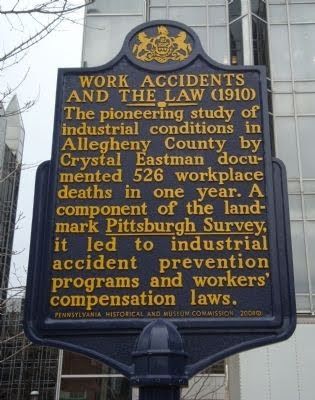
A major historical marker of working-class history in Pittsburgh has disappeared from Market Square where it stood prominently since 2008.
The marker, titled “Work Accidents and the Law,” commemorates a research study and book under the same name completed by American Civil Liberties Union founder Crystal Eastman. One of 2,600 cast aluminum plaques around the state, the marker was removed when Market Square was torn up for renovation in 2025. The renovation was spearheaded by the Pittsburgh Downtown Partnership and guided by strategic plans from the Partnership as well as the Governor’s office and the City of Pittsburgh. The renovation was completed and unveiled on April 22 in time for the NFL Draft, but the marker was no longer there.
Several local residents who care deeply about the marker and its historical significance to the working class in Pittsburgh noticed the marker was missing and started to ask questions.
Charlie McCollester, a local labor historian who wrote the description for the plaque and submitted the request for its content and location in 2008, said he was particularly concerned after noticing the marker was missing in April. He wrote a letter to Mayor Corey O’Connor expressing concern over the marker’s removal and requesting that it be returned to Market Square. He hand delivered this letter, along with a copy of his book “The Point of Pittsburgh,” to the mayor’s office, but never heard back. Calder Buisch, a local labor lawyer and member of the Democratic Socialists of America, also noticed that the marker was missing and brought it to the attention of Steel City Socialist.
Steel City Socialist was able to confirm with the mayor’s office that it was removed during construction and placed in a Pittsburgh Department of Public Works warehouse. The mayor’s office said that they plan to move the marker to a different location and have reached out to the Pennsylvania Laborers’ District Council to help them decide where to relocate it.
Historical markers in Pennsylvania are managed by the Pennsylvania Historical and Museum Commission and their locations are decided by the commission and residents who petition to have the marker erected. The commission’s Historical Marker Policy says: “If a property owner on which an Historical Marker is located requests its removal, Commission staff may remove it and reinstall it at another location.” The owner of Market Square, where the marker was located, is the City of Pittsburgh. The Commission told Steel City Socialist that they are working with the Pittsburgh City Planning Department on the planning and preparation for the marker to be reinstalled this year, but did not specify where.
The marker’s historical importance centers around perhaps the most extensive and groundbreaking worker health and safety study in the country, which documented 526 workplace deaths in Pittsburgh factories in just one year. The study was completed by Crystal Eastman as part of the Pittsburgh Survey and took place from 1906-1907. This research led to our current workers’ compensation law.
After publishing her book, Eastman drafted the first workers’ compensation law in the country. In addition to co-founding the ACLU, Eastman was also a feminist, an anti-World War I activist in Europe and the editor of a socialist newspaper during the first Red Scare. Buisch considers her a “model of who we should all want to be as socialists and as members of a community.”
When it stood, the marker helped present the workers’ side of history to Pittsburghers and tourists alike.
“The reality of the steel industry is that it was truly the worst of the worst of capitalist excess in the United States, where people were dying,” Buisch said. “People were getting permanently disabled, and then having their family starve to death, because they couldn't work anymore in the industry.”
Buisch first noticed the marker by accident due to its prominent and central location in a walkable downtown Pittsburgh area. It was on his route to work and his eyes were primed for it after he learned about Crystal Eastman at the Heinz History Center. The Pittsburgh Downtown Partnership and O’Connor’s office both declined to comment on the decision to relocate the marker instead of replacing it to its original location. The mayor’s office has stated it is working to relocate it with an unspecified timeline.
McCollester and Buisch said it should stay in Market Square, as it was put there by the Pennsylvania Historical and Museum Commission for a reason. Formerly located in a pedestrian park, the marker allowed both tourists and locals to stumble across its history easily, and it is located near the United Steelworkers building. The square is also the longtime site of an annual Workers Memorial Day observance, which commemorates workers killed or injured by their work.
McCollester said that no one was able to find where exactly Crystal Eastman lived in Pittsburgh, so it could really go anywhere — but the high exposure and proximity to the United Steelworkers building and Workers Memorial Day make Market Square a good location.
“It's very frustrating that I think one of the few places where people would be exposed to Crystal Eastman and exposed to the history of class and capitalism in America is getting taken away or moved out of a place where people actually would see it. It feels like it's gonna be covered up and tucked away,” Buisch said.