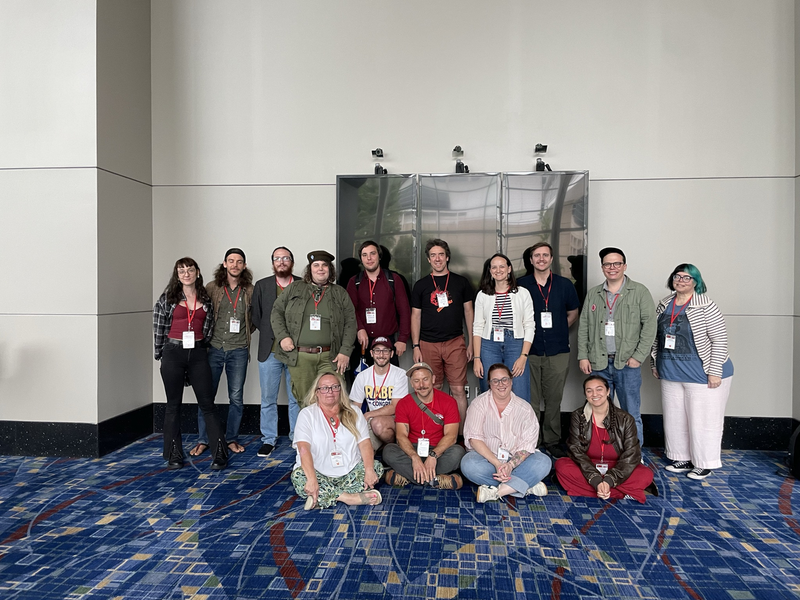
When Sam Margolin decided to join the union campaign at Humane Animal Rescue of Pittsburgh, she didn’t bring much organizing expertise with her.
“I really didn’t know what I was getting myself into,” Margolin, an admissions and adoptions counselor at the nonprofit animal welfare network, said. “I didn’t know a lot about unions.”
Margolin and her coworkers have taken a crash course this year. In June, the National Labor Relations Board certified a razor-thin 2023 vote as a victory — prompting the newly unionized workers to seek public support and demand a contract with their bosses.
The more than 80 Humane Animal Rescue workers join a small but growing handful of organized animal shelters and rescue agencies across the United States. Workers at an Austin, Texas shelter unionized in 2024, and those at the Baltimore Animal Rescue and Care Shelter in Maryland voted this September to recognize a union.
“It’s really cool getting to pave the way it should be,” Margolin said.
The Pittsburgh-area workers are spread across three locations, tending to dogs, cats, rabbits and other species as they connect with foster caregivers and adopters. One Humane Animal Rescue location, in Verona, is responsible for wild animals. Workers at the three sites help spay and neuter animals and provide medical care; the organization’s statements describe its goal as “a community where every animal is free from cruelty, neglect and need for necessary care.”
The work comes with real difficulties: feral animals, creatures at risk of rabies, even angry human visitors and pet owners struggling with homelessness or imprisonment.
“It’s such a high-stakes, very emotional and physical job. It’s very seriously traumatizing,” Margolin said. “But each day is different. … We’re all there because we love it.”
Workers at Humane Animal Rescue began their union drive years ago, with the original effort culminating in 2023 in legal limbo. Initially, four of the union member’s ballots were challenged by the employer and excluded, with the employer claiming a 41-39 vote against recognizing the United Steelworkers union. Those four additional votes hung in the balance, subject to a lengthy dispute through the National Labor Relations Board.
Pro-union workers said the original campaign faced intense surveillance and anti-union activity by managers.
“Management … has spent more than half a million dollars on union-busting lawyers trying to deny its workers the right to form their union,” pro-union workers said in a petition earlier this year. “This is money that could have gone toward caring for animals: upgrading facilities, hiring more staff and finding more forever homes.”
Representatives of Humane Animal Rescue’s leadership declined an interview request. In a written statement, they said: “HARP is committed to bargaining in good faith with the USW as we work toward a first contract.”
Employee turnover and the long wait for a ruling on the disputed vote prompted some workers to consider relaunching the union campaign from scratch, Margolin said. Then, this year, the labor board certified the vote — including the four challenged votes, to result in a 43-41 union win.
This ruling boosted the union’s organizing committee, with members dividing up by team and location to hold one-on-one talks with coworkers. Some workers were skeptical of the campaign after the original drive, Margolin said, while others had absorbed negative ideas about unions.
“It was really interesting to see so many people’s perspectives and seeing how different people view unions,” she said.
Organizers have turned to well-known methods to stay in contact with their scattered members: text chains, contact lists and bulletin board posts, as well as bargaining surveys to collect workers’ demands for a contract. As in almost any union drive, the organizing has to continue — or even ramp up — as workers proceed from a successful vote to a first contract.
Members have concerns familiar to almost any worker, from pay and hours to health and safety protections, as Margolin described it.
Driven in part by a changing U.S. workforce and in part by a wave of militancy, new industries — like animal care — that previously had little to no union representation have seen fresh organizing in the past few years. Baristas, salon workers and rideshare drivers have been involved in strikes and union drives, developing new tactics and building a culture of rank-and-file organizing.
Recent polls have shown growing interest in unions, particularly among younger workers. The pollster Gallup found last year that 68 percent of Americans approve of unions, while a series of studies analyzed by the Economic Policy Institute showed that a growing share of workers would vote yes for a union if the opportunity arose.
For organizers like those at Humane Animal Rescue, a key step is helping workers realize they make up the union and wield power at their jobs.
“The union is whatever we want it to be,” Margolin said. “We’re the ones doing everything.”