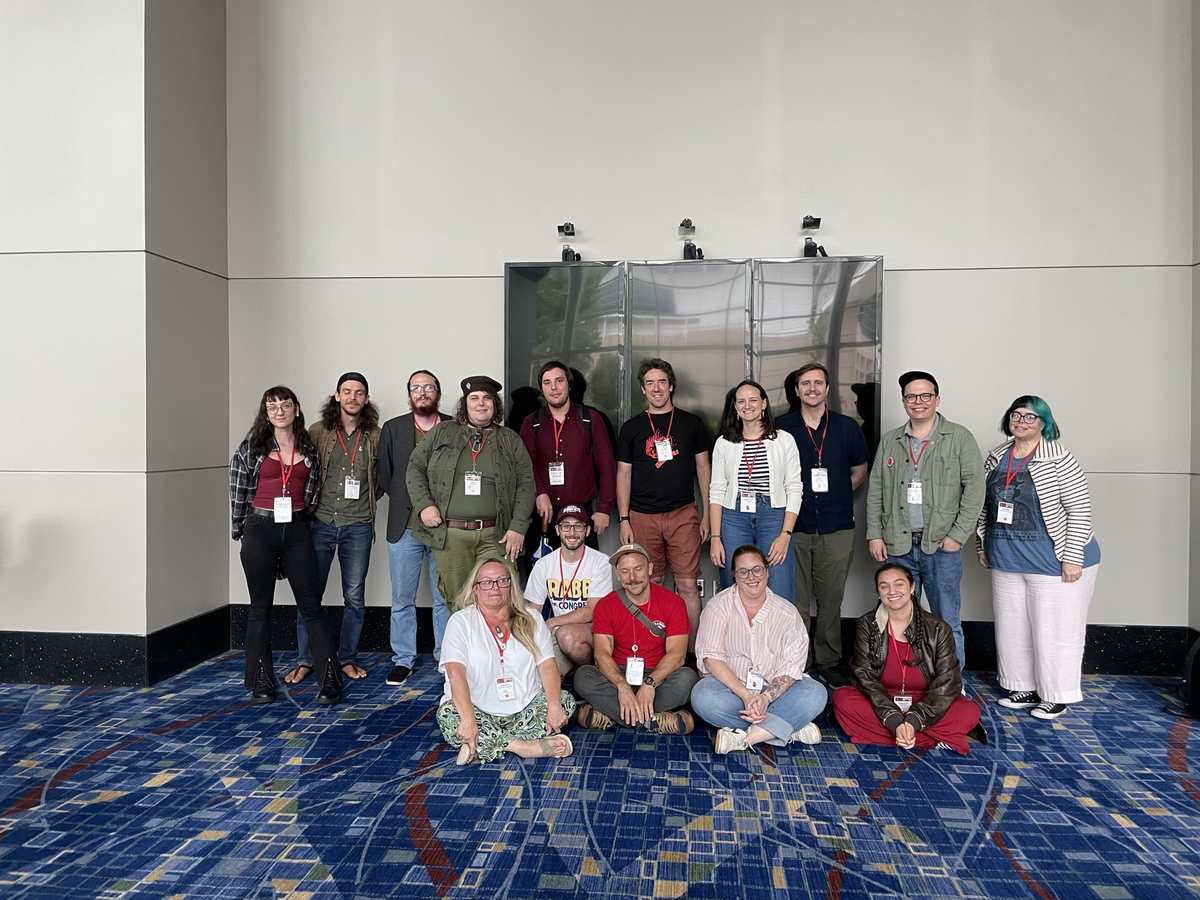
DSA members from across the country gathered July 31 to Aug. 2 in Chicago for the organization’s first-ever Socialists Summit. Organizers sharpened their skills, socialized and learned about the struggle for Palestine, the movement toward a nationwide strike and the fight against ICE, among other missions. Five Pittsburgh DSA members reflect below on their experiences at the summit and the state of the movement.
Dylan B.
I had a wonderful time in Chicago meeting members of DSA from across the country in breakout sessions, socials and panel discussions. The workshops and talks I attended in the Governing as Socialists track covered crucial lessons on how and why DSA’s electoral program has succeeded so much over the past few years.
DSA’s organizers were laser-focused on effective strategies for building our bench of socialists in office and creating durable policy changes in the process of co-governance between elected socialists and local DSA chapters. DSA’s elected officials at the conference included Chris Rabb, Democrat of Pennsylvania preparing to take up a U.S. House seat, and incoming state lawmakers Robert LeVertis Bell of Kentucky and Tammy Carpenter of Oregon, among many others. It was also a pleasure to meet with summit attendees from other chapters in Pennsylvania, where we coordinated on how to support each other’s efforts and build statewide campaigns to bring pro-worker, pro-family and pro-justice policy to Harrisburg.
I left prouder than ever of the movement we’re building across this country and the people in it. If we keep bringing in more Americans and proudly representing our values like people did in Chicago, we’re going to change America forever.
Tzipora S.
Socialists Summit was a great opportunity to interact with DSA members from across the country without the pressure and high-stakes debates of the National Convention. I participated in the Palestine track, where presentations were facilitated and headlined by members of the International Committee and members organizing for Palestine in their chapters.
Some of these were participatory or roundtable discussions, like the power-mapping session where we broke down the balance of forces within the Palestine solidarity movement and its enemies. Others were panels, such as the presentations for No Appetite for Apartheid, Labor for an Arms Embargo and Palestine solidarity at the municipal level. I was asked by the organizers to be on this third panel to talk about Not On Our Dime, a Pittsburgh campaign to stop funds for Israel’s genocide in Palestine.
At the panel, I went over the history of the campaign, what the canvassing was like and the obstacles the campaign encountered that led to its failure. Though reporting on a failure didn’t feel good, I was reassured by the other panelists who reported on more successful campaigns, as well as conversations I had with other attendees.
The Summit was an opportunity to take stock of the state of the Palestine solidarity movement. It’s clear that since Oct. 7, the movement in the U.S. has grown substantially and had major victories in local divestment and consumer boycotts. Pro-Palestine candidates have shown that they can win elections, and candidates supported by Zionist lobby organizations are increasingly seen as toxic by voters. Campaigns are now going after larger boycott, divestment and sanctions targets like the military contractor Elbit, and efforts are underway to link the Palestine solidarity movement with the labor movement to advance BDS on new fronts.
However, there have also been setbacks. Repression has substantially weakened the student movement in particular. Street protests are fewer and smaller. Many organizers are burning out, and some older organizations are shrinking or facing internal debates on how to move forward. In order to continue advancing, it’s clear that the movement will need to adapt to changing circumstances, find new allies and link up with other liberatory movements. DSA, as a socialist party with a strong program and a commitment to internationalism and Palestinian liberation, is well-equipped to forge these links and demonstrate that the liberation of Palestine is a vital part of the workers’ movement here at home.
I also had the opportunity to co-host a Kabbalat Shabbat service for other anti-Zionist Jewish comrades attending the summit on Friday. Hopefully this will become a feature of other national DSA events too, which often take place over the weekend during Shabbat.
I left the summit more excited about DSA than ever before, with new ideas about how to make our chapter more effective.
Melanie H.
The Socialists Summit was my first major experience with DSA outside of the Pittsburgh chapter. I participated in the Organizing Fundamentals track, which offered many helpful resources. The Organizing Conversations workshop offered a procedure for how to involve people more deeply in organizing work, and led roleplay scenarios to practice handling the awkward silences (or unexpected responses) that can pop up. I also appreciated the advice offered in the Conflict Without Fear workshop: don’t depend on structural changes to fix organizing and persuasion problems, and separate conflicts into their personal, ideological and structural components.
Talking to folks from throughout Pennsylvania and beyond expanded my understanding of how DSA organizing can be structured. It was also clear that many of the challenges we’re facing — such as managing capacity, bringing in new members and prioritizing campaigns — are shared across chapters. The path ahead may not be easy, but the summit reinforced for me that we’re not in this fight alone.
Zoe T.
I connected with so many comrades, some that I had known for years, but many were new faces. The format of the summit allowed me to get out of my comfort zone and talk to people with whom I may not agree 100 percent on their vision for our organization. I learned a lot from the workshops in the Fundamentals of Organizing track that I hope to bring to our chapter.
I think the most impactful workshop I went to was the “Organizing Conversations Training/Roleplay.” This training made me think that Pittsburgh DSA should have at least one organizing conversations training every quarter. The conference opened my mind to a lot of common problems I have been seeing in the chapter.
I think by integrating what we all learned from the summit into the organization, we will see more growth and development in our membership. I hope we as a chapter send even more folks to the next one.
Cassandra M.
I had an energizing long weekend in my hometown! I was in the Socialists in Office track, and I especially enjoyed the session diving into the DSA Difference in elections, as well as the session on anti-ICE organizing in New Jersey, Boston, Seattle and Milwaukee.
The fundamental lesson I’m carrying with me back to Pittsburgh is that the DSA vision is to create a sustained program of contesting power. We cannot cede power before it’s contested. I actually left the summit feeling daunted to return home, frustrated at all the power our chapter leaves on the table. We cede our own power before it’s even contested through poor internal organizing and weak commitments to one another and fellow workers. No one person or cadre is to blame, but we all have a responsibility to fix it.
One big way we cede our own power? We spend more time debating our capacity than we do actually creating and sustaining it. A Syracuse DSA comrade at the summit said, “DSA chapters have a lot of load-bearing people,” and I audibly gasped at how true it is. A lot of us are really good at tasks: making a Solidarity Tech RSVP form, writing resolutions, scheduling a social, picking up pizzas. Many of us are good at creating and supporting roles for people, especially through our committees’ many positions. But it’s time more of us deeply commit to being organizers, committed to a leadership ladder in everything we take on, which in turn fosters a good home for members.
When we commit to organizing, we create capacity, we create new leaders and we create room for more impact, democracy and 1,000 more members.
When we build up other people to lead, our power grows exponentially. We cannot continue ceding power before it’s even contested.